CD: digital optical used to store any information ( audio, images, video , documents and other data).

CD-ROM: Compact Disc used for storing nonvolatile information, the same means used by audio CD can be read by a computer with CD reader. A CD-ROM is a flat plastic disc with digital information encoded in a spiral from the center to the outer edge.
 CD-RW: is a digital optical used to store any kind of information. This type of CD can be recorded multiple times, as it allows stored data is deleted. Was developed jointly in 1980 by companies Philips Sony , and began shipping in 1982.
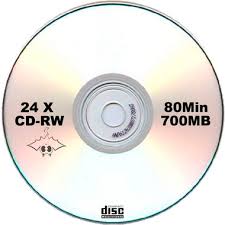 CD-R: is a form of recordable compact disc. (Compact Disc Recordable Compact Disc Recordable =). You can record several sessions, but the aggregate information can not be erased or overwritten, instead you must use the space left by the preceding session.
  MINI-CD: MiniCD are The CD Small Form, also known as Pocket-CD . When Mini CDs were first introduced in the United States were initially marketed as CD3, referring to Approximate size in inches ; the larger CDs were called CD5, this despite the fact that both specifications were defined only in terms of metric. These names have not gained acceptance.
  BLU-RAY: format is an optical disc new generation of 12 cm in diameter (same as CD and DVD ) designed by Sony for high-definition video and high data storage density. Its storage capacity reaches 50 GB double layer and a layer 25 GB, but there are larger capacity. The PlayStation 3 console can read up to double layer discs, and has confirmed it is ready to receive the disc at a rate of 16 layers 400 GB
DVD: The DVD, whose initials stand for digital versatile disc or digital versatile disc is an optical storage standard which emerged in 1995.
 DVD-RAM: rewritable DVD format approved by the DVD Forum. It differs from the DVD-RW (and DVD + RW) that do not need to erase the entire disc space to retrieve the content we want clear and you can record directly to it like a hard disk, without of DVD burning software, programs or drivers (in the case DVD-RAM recorders Computer).
DVD-ROM: A DVD-ROM (read: 'de-vee-rom') or "DVD" Read Only Memory "(English DVD-Read Only Memory) is a DVD that belongs to WORM media, ie, like a CD-ROM has been recorded only once (shaped recording method) and can be read or reproduced many times.

DVD-R: A DVD-R or DVD-Recordable (DVD-Recordable) is an optical disc which can record or write data with much greater storage capacity than CD-R, typically 4.7 GB (in Instead of storing 700 MB of standard CD), although the capacity of the original standard was 3.95 GB. Pioneer has also developed a version of 8.5 GB dual-layer, which appeared on the market in 2005.
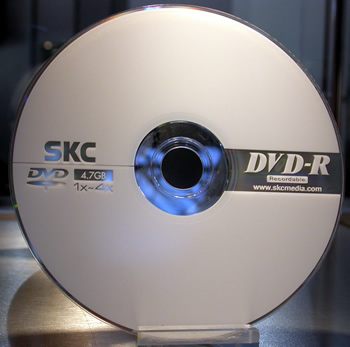
DVD-RW: A DVD-RW (Minus Rewritable) is a rewritable DVD which can record and erase information repeatedly. The standard capacity is 4.7 GB. was created by Pioneer in November 1999 and is opposed to the format DVD + RW, further supported by Panasonic, Toshiba, Hitachi, NEC, Samsung, Sharp, Apple Computer and the DVD Forum.
NOR Flash Memory: The NOR type flash memories, where the electrons are in FG, modify (almost nullify) the electric field that generate CG should be active. Thus, depending on whether the cell is 1 or 0, the electric field of the cell exists or not. So when the cell is read by placing a specific voltage on CG, the electric current flows or not depending on the voltage stored in the cell. The presence / absence of current is detected and interpreted as a 1 or a 0, thus reproducing the stored data. Devices in multi-level cell, detects the amount of current to control the number of electrons stored in FG and interpret properly. To schedule a NOR-type cell (assign a specific value) is allowed to pass current from the source terminal to drain terminal, then placed into GC a high voltage to absorb and retain the electrons in the electric field generated . This process is called hot-electron injection. To clear (set to "1", the natural state of the transistor) the contents of a cell, eject these electrons, the technique uses Fowler-Nordheim tunneling, mechanical tunneling process - quantum. That is, apply a fairly high reverse voltage used to attract electrons, making the transistor in an electron gun which allows opening the drain terminal, the electrons leave it. This process is what causes the deterioration of the cells on a conductor by applying a voltage so thin that high. It should be noted that flash memories are divided into blocks (sometimes called fields) and therefore, to erase, entire blocks are cleaned to expedite the process because it is the slowest part of the process. For this reason, flash memory are much faster than conventional EEPROM since erased byte by byte. However, to rewrite a data block must be cleaned first and then rewrite your content.

Memory NAND Flash: Flash memories based on NAND logic gates work slightly differently: using tunnel injection for writing and erasing a tunnel of 'loose'. The NAND-based memories are also the obvious base in other types of doors, a much lower cost, about ten times more resistant to the operations but only allow sequential access (more oriented to mass storage devices), compared to NOR-based flash memory allowing random access reading. However, they have been the NAND which have allowed the expansion of this type of memory, because the deletion mechanism is easier (although be erased blocks) which has provided a more cost effective to create such devices memory card. The popular USB flash drives or also called pen drives, using NAND-type flash memory.

USB Memory: A USB (Universal Serial Bus; in English Pen, USB flash drive) is a storage device that uses flash memory to store information that may require and requires no batteries (batteries). The battery was required in earlier models, but the most current and do not. These memories are resistant to scratches (external) dust, and some water, which have affected previous forms of portable storage, such as floppy disks, CDs and DVDs. In Spain they are known popularly as skewers or pencils, and other countries like Honduras and Guatemala are known as memories.
These reports have become the storage and transportation system personnel data used in this application moving to the traditional floppy disks, and CDs. You can easily find market reports 1, 2, 4, 8, 16, 32, 64, 128 and up to 256 GB; be impractical from the 64GB because of its high cost. This means, at least the equivalent of 180 700MB CD or floppy 91,000 approximately 1.44 MB. Its popularity has meant plenty of popular names related to their small size and different styles, none of which has been noted among them. The adjective USB or the context itself can easily identify the computing device to which they relate.
Current operating systems can read and write the reports simply by plugging into a USB connector of the computer on, receiving the power supply via the connector itself with 5 volts and 2.5 watts maximum. In some older computers (such as those equipped with Windows 98) you need to install a device driver (driver) provided by the manufacturer. Linux also has support for USB storage devices from the 2.4 kernel.

VIDEOS:
Unitary Price:
CD: Currently, blank CD prices vary, depending on whether purchase tubs or boxes with between € 0.2 and € 0.9 per unit.
DVD: whereas the average price of a DVD may be around the € 0.80 the fee is around 55 and 75% of the DVD. BLU-RAY
: that record prices has much to lose as the costs are higher, as reflected for example in the readers.


0 comments:
Post a Comment